How to Choose an Instagram Influencer Marketing Agency


You need an Instagram influencer marketing agency that gets your offer in front of the right audience for less money. Compare the total cost of working with comparable influencers, including agency fees.
Test the agency’s promises with a small first campaign: who was found, who was contacted, who agreed, what was published, and what it cost. Then you’ll know what to pay for next.
This article explains how to choose a team to manage sponsored posts for your brand on Instagram. Managing your store’s account, representing an influencer, and selling access to a contact database are different services.
Our general guide to choosing an influencer marketing agency explains why transparency matters when you want to repeat a result. Here, we’ll show how to check that in an Instagram agency’s proposal.
How can you assess the agency’s sourcing and outreach?
An attractive shortlist in a presentation is not enough. Ask to see a completed Instagram campaign similar to yours: who the agency looked for, how it chose them, what it offered, and how many posts went live. Ask for an anonymized list and messages to support the explanation. To judge the response rate, ask how the agency contacted influencers, whether it offered products or payment, and whether it approached smaller or larger accounts.
Then ask: does the agency work only from an existing database, or does it search Instagram specifically for your brief? Have it explain, using a few examples, how it found those influencers and why they fit your product and audience. That’s enough to understand the method. Expect to pay for sourcing tailored to your project.
A search tailored to your brief may turn up suitable influencers who have never worked with brands and don’t list an email for brand deals. The agency will need to DM them if their messages are open, explain the offer, agree on the terms, and help them get their first sponsored post live. Your brand could be their first sponsor. Check their past posts and ask about previous collaborations. Having no contact email doesn’t tell you whether they’ve worked with brands before.
Ask about timing too: when you’ll receive the shortlist, when outreach will start, and what needs to happen before the first post can go live. An exact date is not always possible before an influencer replies. But the team should explain what it will do and how long it expects the work to take.
How should the agency find influencers for your product?
Suppose an online store in the US sells hand cream and cuticle oil as a kit. Its customers are women who get manicures. The campaign will focus on hand care at home between salon visits.
The agency could start with searches such as hand care routine, cuticle care, and at home manicure. Ask which searches it would try and how it would assess the accounts it finds.
An influencer sharing their own at-home routines could fit, as could a nail technician explaining aftercare to clients. But an influencer teaching professional techniques to other nail technicians is addressing a different audience. Matching words in a profile do not make an account suitable for promoting the kit.
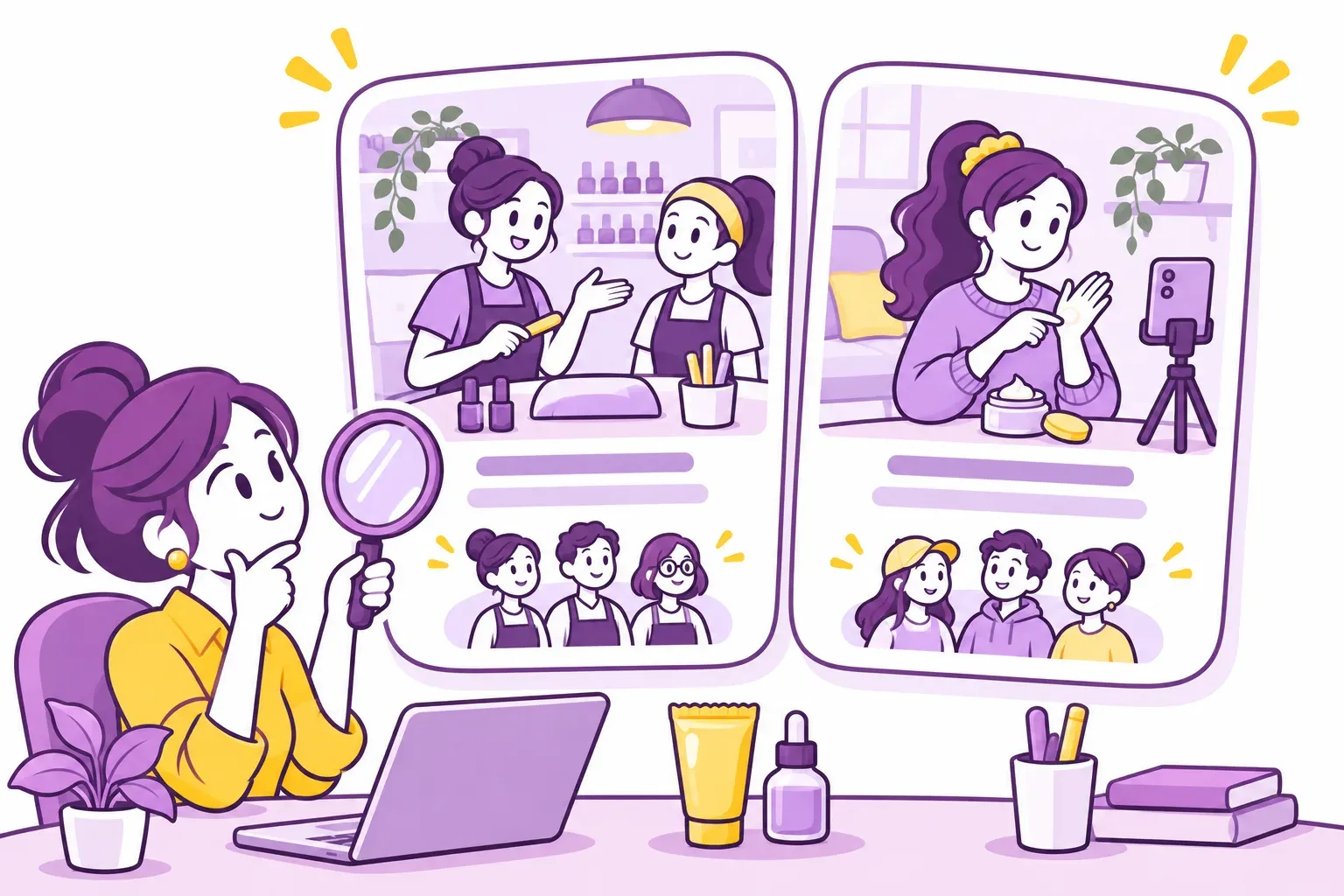
Who is in this audience, and why might they buy the kit? Some answers are visible in the posts; others require information from the influencer. These three examples show accounts at different stages of assessment. They focus on content and geography; account activity, audience size, and the rest of the brief still need to be checked.
| Candidate and available information | Our decision |
|---|---|
| An influencer shares their at-home hand-care routine. They have supplied audience analytics; the agency has recorded the date and checked audience locations against the store’s requirements | Discuss the fee and format, and confirm whether the influencer wants to take part |
| A nail technician features both professional techniques and at-home care. It is unclear whether the content addresses other professionals or consumers, and audience locations are unknown | Get in touch to clarify. Do not treat this candidate as vetted yet |
| The content fits, but the audience does not meet the store’s location requirements: the store does not ship to those locations | Exclude from this test |
A nail technician with the right consumer audience could still qualify. The shortlist should show the reason for each decision, the source of the information, and what remains to be checked. A location in a profile is not a substitute for audience-location data.
Ask the agency why it would approach some candidates before others. Experience shows in its ability to weigh audience fit against price. Rigid filters—“too many bots” or “not enough women”—can rule out a worthwhile post. Suppose 80% of one influencer’s audience looks suspicious, but the sponsored post costs one-tenth as much as another’s. That influencer may still be worth considering. How many people in your target audience could see the post at that price? The remaining 20% need to be vetted, too. Just because someone doesn’t look like a bot doesn’t mean they’re a potential customer. In an experiment with Dutch Instagram users, Janssen and colleagues found that a larger following helped only when the product fit the influencer’s image. The study wasn’t run in the US, and it measured how people felt about the ads and whether they said they’d buy, not actual sales. Still, it’s another reason to look beyond follower count. Study summary, Tilburg University.
If you plan to handle sourcing yourself, our guide on how to find influencers for your brand covers that process.
How should you choose between Reels, Stories, and carousels?

Why this format fits your goal
Ask the agency: why are you recommending this format for our product, who do you expect it to reach, and what is that estimate based on? Reels can reach people beyond an influencer’s followers, but photos and carousels are not limited to followers either: Instagram recommends posts in Feed and other parts of the app. The rule “Reels reach new people; posts reach followers only” doesn’t hold up. Meta on Feed, and recommendations.
For our kit, we could consider different approaches:
| Format | What to show | What to check with the influencer |
|---|---|---|
| Reel | How the cream and oil fit into an everyday routine | Results from several similar videos: who they reached, including non-followers, and how viewers responded |
| Carousel | Explain how to use the two products step by step and answer questions | Performance of the influencer’s similar carousels: reach, saves, and product questions |
| Stories | The influencer’s experience with the products, answers to questions, and a link to the kit | Views across the Story sequence, analytics for each frame, and link clicks the influencer can report |
Check analytics for the format you are actually buying. A popular Reel does not mean people also watch that influencer’s Stories. Follower demographics don’t tell you who actually watches a video, so ask the agency to separate known viewer data from assumptions. What matters to the store is how many viewers could become customers.
You can also discuss a Collab post with the store’s account. Once the invitation is accepted, the post appears on the participating profiles and can be distributed to their audiences. A Collab needs its own agreement. It’s different from a brand tag or paid promotion, and it won’t necessarily double your reach. Meta on Collabs.
The central message stays the same: hand care between manicures. Each influencer can tell that story in a different way and format. Agree on the number of deliverables and their cost separately.
For the first campaign, we recommend a group of micro-influencers. That gives you several shots at finding the right story and audience. If you spend the entire budget on one person, it’s harder to tell why a campaign fell short. Because each influencer has a different audience and works under different conditions, this is not a controlled experiment. Use the comparison to choose the next test, rather than as proof of what caused a purchase.
What to agree on before posting
For one influencer, for example, you could agree on this combination:
- Message: show hand care at home between salon visits.
- Content: a Reel demonstrating the cream and oil in the influencer’s usual routine, with accompanying Stories about the kit.
- Next step: in the Reel, the influencer invites viewers to visit their profile and watch the Stories about the kit; a link there takes them to a page with product details, the price, and a way to buy.
- Terms: the posting window for the Reel and Stories, how long the Stories and product link will stay up, payment, revisions, and the analytics the influencer can share.
The brief should make the opening, product demonstration, and viewer’s next action clear. “Save this tip” alone does not help someone find the price or buy.
Decide in advance how viewers will find the kit if they watch the Reel after the accompanying Stories are no longer available.
For a US campaign, follow the FTC’s Endorsement Guides. If the audience wouldn’t expect a connection between the brand and the influencer, such as payment or a free or discounted product, it generally needs a disclosure that’s hard to miss and easy to understand. When a Reel promotes the product both on screen and out loud, disclose the sponsorship both ways. Instagram’s paid partnership label may not be enough on its own. The brand, agency, and influencer can all be liable, so agree on the wording and who will check each post. If you also target other countries, check their rules.
Review product claims separately: in our example, everyday care should not become an unsupported promise to treat a condition or make a manicure last longer.
Before the content goes live, the agency and influencer should test the path from the post to the product page on a phone. The store should check the kit’s product page: are the product details, price, and delivery terms clear, and do checkout and any promo code work? If the content shows two products but the link goes to a general catalog, fix that before launch. Decide who will answer customers’ questions.
What goes into the cost of an Instagram campaign?
For the first test, we recommend separate payments for sourcing, outreach, and published posts. Review the completed work and decide whether to continue before paying for the next stage.
First, figure out what you’re buying. “Ten influencers” can mean a list of candidates in one proposal and ten published posts in another. Ask for a breakdown of the full cost of a sponsored post: agency fees, influencer fees, product costs, and shipping.
Then compare how many of the people you want to reach might see the content for that money. Two proposals with the same follower count and number of deliverables aren’t necessarily equal. Ask the agency what data its estimate rests on and what it does not yet know. That makes it easier to judge whether a more expensive post is worth the price. Before launch, this is an estimate to test, not a promise of views or sales.
Write down your spending limit and the stage at which you can stop. Check what you would still owe for completed work and posts already booked with influencers.
Distinguish between a post on the influencer’s account, the brand’s use of the content, and paid promotion. If you want the video files for your own account, website, or ads, agree on usage rights separately: which videos you receive, where you can use them, for how long, what edits are allowed, and any permissions required.
Meta’s partnership ads allow paid promotion that displays a partner’s account and requires separate permissions. If they are included in the proposal, clarify who will manage them, the budget, and the permissions. They’re optional in our first test, since we’re starting with posts on influencers’ accounts. Meta’s overview, permissions documentation.
What does the agency handle, and what are you responsible for?
You can delegate sourcing alone or the whole process through reporting. In our example, the agency finds influencers, negotiates with them, follows through until posts go live, and hands over the records and analytics. The store is responsible for the product, accurate product information, shipping, the product page and checkout, and order data. You decide what to sell, to whom, and at what price.
Talk through what happens if something goes wrong. Say an influencer gets the kit late and can’t post on time. Who proposes a new date or a replacement, and who approves the costs? Settle this in advance, along with the revisions included in the price. Judge the agency by whether it delivers the agreed-upon work. To assess the campaign, compare the full costs with the results. Good execution alone does not guarantee that your offer will pay off.
What should you have after the first campaign?
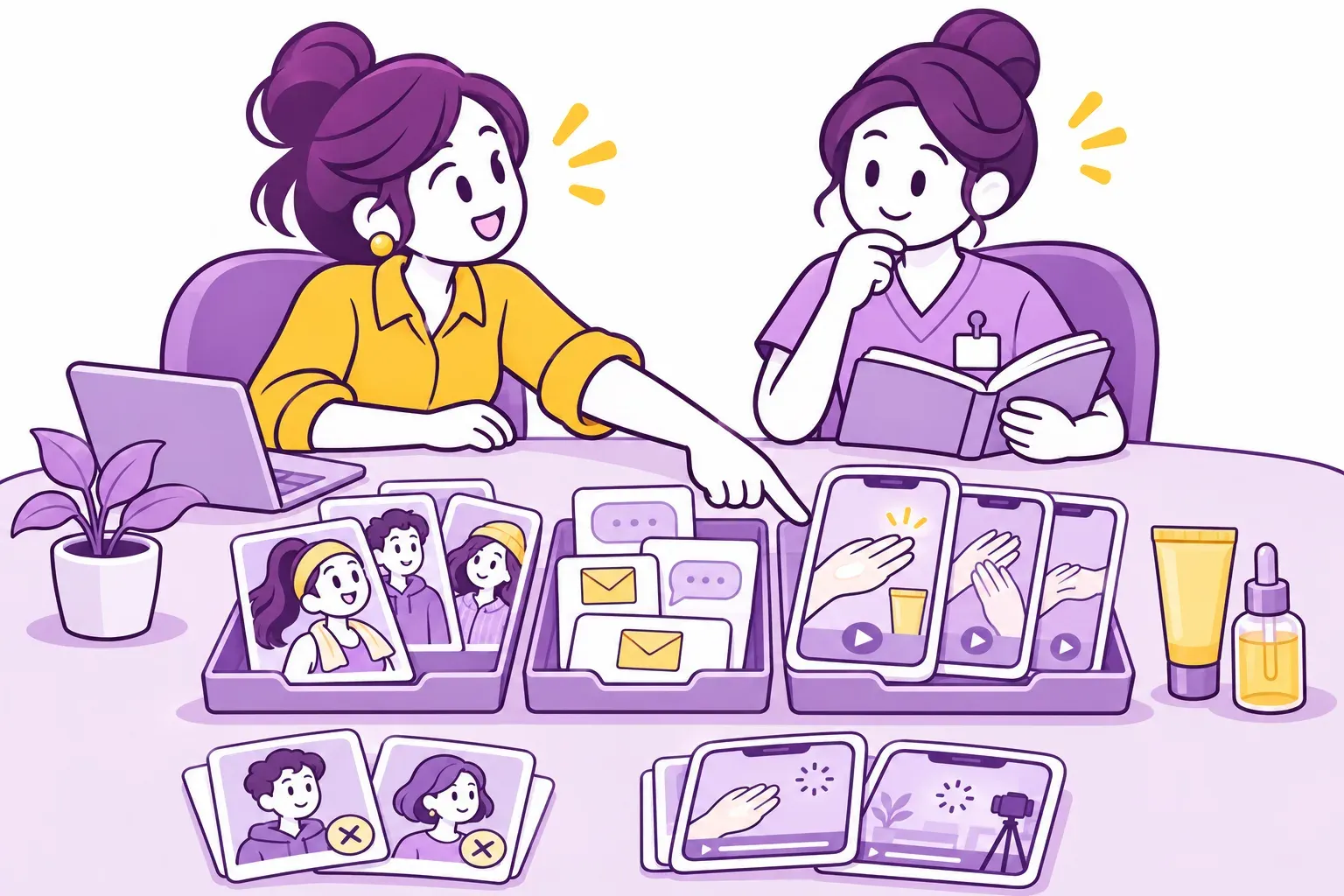
After the test, you should receive the candidate list with reasons for selection, messages and replies, collaboration terms, proof of posting, and costs. Keep a record of influencers who declined and of posts that were agreed on but never went live. Before launch, look at a sample report and confirm who will provide each part.
For a Reel, save the link and the content with its caption; for Stories, save all agreed-upon frames in the right order. One frame does not prove the whole sequence went live. Separately, note which metrics the influencer will share, when, and for what period. For Stories, clarify the data available for each frame, especially the one inviting viewers to the product page. Before you pay, find out which data you won’t be able to get.
For each post about the kit, record how the product was shown, what viewers were offered, and where the link led. Add the cost, tracked visits and orders, and an explanation of how they were attributed to the campaign. Note changes to price, shipping, and the page too: if those change, rerunning the same video isn’t the same as rerunning the campaign.
Report views, audience response, and purchases separately. They measure different outcomes in influencer marketing research too. Pan and colleagues, Journal of the Academy of Marketing Science.
Next, identify the stage where work stopped or results were weak:
- Too few suitable influencers found. Review the criteria and search directions. Is a broader search worth trying?
- Suitable influencers found, but few agreed. Review the offer, contact channel, and terms. Before paying the agency to find more influencers, understand why the first group declined.
- Agreements reached, but posts did not go live. Check execution, deadlines, and approvals.
- Posts went live, but sales were low. Review the content, path to purchase, store’s offer, and how sales were tracked. The report should help you choose the next thing to investigate, rather than blame everything at once.
Suppose the posts about the kit went live and Stories drove traffic, but sales are still low. People keep asking how to use the oil with the cream: the videos showed application, but the routine was unclear. The store should clarify the explanation on the kit’s product page, and the agency should include it in the brief for a repeat post before you pay for another large round of sourcing. This does not prove what caused the weak sales, but it gives you a specific question to test in the next round.
Add up the full costs, the orders you could attribute to the campaign, and how much you earned from them. If you don’t have much data, don’t call the channel a success or a failure yet. Even if you can track an order to the campaign, that customer might have bought anyway.
After that review, you should know what work to pay for next: finding more influencers, changing the offer, repeating successful collaborations, or trying another content approach. That’s what transparency is for. It doesn’t guarantee that doubling your budget will double your sales.
What should be clear before you pay?
Ask several suitable agencies to respond to the same brief. Compare their answers on four points:
| What you need to know before paying | What to record |
|---|---|
| What you are paying for | The deliverable for each stage, quantity, full cost, and deadline |
| When to continue | Who approves the next stage and what stopping would cost |
| What costs extra | Work and expenses outside the quoted amount |
| What you keep | The deliverables and records handed over, in what form, and when |
It’s fine to follow up on missing analytics or a date that depends on an influencer’s reply. But if the team cannot explain its sourcing, will not say what you receive for your payment, or will not agree to hand over the deliverables and records from each stage you pay for, we’d look for another agency.
If you need a small first campaign, agree on its scope, then review the report before committing to more work. A team that only takes on large campaigns and requires a commitment to the full scope upfront isn’t the right fit for that test.
Ask us the same questions
Tell EPICSTARS about your product, market, goal, and expected budget. We’ll discuss what sourcing and campaign management your first test would involve, and what you’ll receive at each stage.